Shevchenko Street
Grey BeesShevchenko Street is one of the two proper streets in Little Starhorodivka, the road where Pashka Khmelenko lives and where the village’s last inhabited houses stand amid the war’s disruption. It lies across from Sergeyich’s Lenin Street, close enough for the men’s parallel lives to remain divided by their old enmity, yet near enough that wartime isolation eventually makes the two neighbors depend on one another. Later, Sergeyich rearranges the street signs and declares himself a resident of Shevchenko Street, making the road’s name part of his personal, improvised response to the village’s altered order.
Setting and Wartime Geography
The village has only two proper streets: Lenin and Shevchenko, as well as Ivan Michurin Lane. Sergeyich lives on Lenin, while Pashka’s garden faces toward Horlivka and is therefore one street closer to Donetsk. The geography makes the roads more than addresses: they orient the remaining residents toward opposite sides of a landscape occupied by armed forces and scarred by fighting. Sergeyich’s own garden faces toward Sloviansk and slopes down to a field that rises again toward Zhdanivka, hidden behind a hump where Ukrainian army dugouts and trenches have been dug.
The front line is not visible from Sergeyich’s garden, but it remains present in sound and awareness. The Ukrainian army has occupied its positions for three years; beyond Pashka’s street and gardens, local fighters and Russian military personnel have their own dugouts. The war has also emptied the fields between the village and Zhdanivka of their workers. Shevchenko Street thus belongs to a village whose ordinary street plan persists even as the surrounding countryside has been reorganized by trenches, military positions, and abandonment.
Pashka’s Street and the Neighbors
Pashka is Shevchenko Street’s remaining resident and Sergeyich’s old school enemy. They were almost exactly the same age, and their school class had only two boys, so Sergeyich remembers having an enemy rather than a friend. The narrative qualifies the word: Ukrainian offers vrazhenyatko, a harmless little frenemy, for the sort of adversary no one truly fears. Yet the accumulated slights—dirty fighting, tattling to teachers, and refusing to let Sergeyich copy during exams—have not faded. Their neighboring streets preserve the separation of their parallel lives, which might have continued without conversation if the war had not left them nearly alone.
That separation becomes literal after a shell makes a large crater between Lenin and Shevchenko. Pashka explains that he told the local armed men he was the only person left, and that they could no longer drive from one street to the other. The crater both blocks passage and gives the old division a new, physical cause: the men’s streets are no longer simply parallel addresses but parts of a village divided by bombardment and the practical limits it imposes.
Renaming and the Exchange of Signs
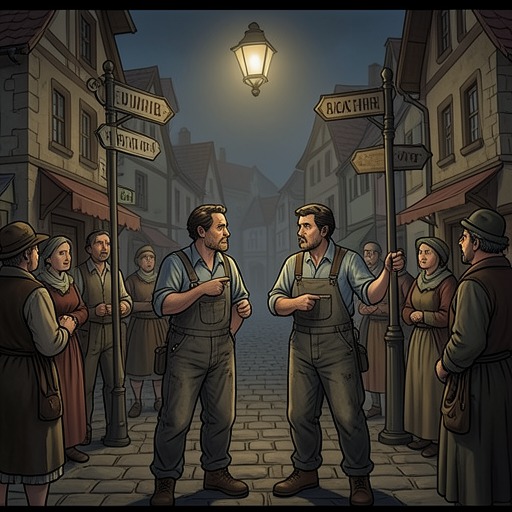
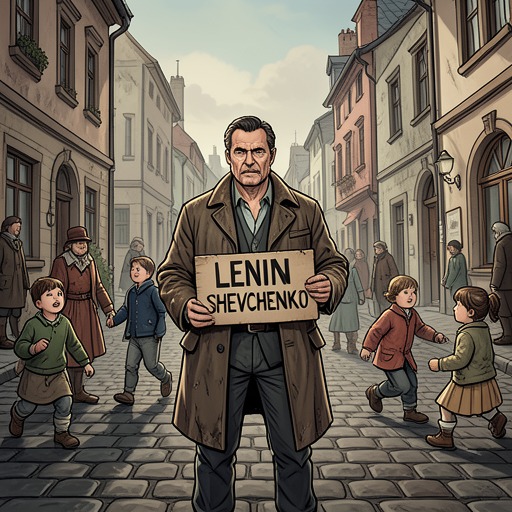
In the night, Sergeyich carries out a deliberate exchange of street signs. He first lays the signs in his yard, then walks to Shevchenko Street and prises six SHEVCHENKO signs off fences. There are no more to collect, despite the two streets having almost the same number of houses. He accounts for the imbalance through the Soviet hierarchy of names: Lenin had been more important, and his name famous throughout the world, while Shevchenko was known only locally. Sergeyich dismisses the distinction by deciding that poets are harmless, unlike politicians, and resolves to live on Shevchenko Street.
He nails a SHEVCHENKO sign to his own fence, replaces the sign at the street’s beginning, and puts another before the last house on the right, nearest the church. Before dawn, he returns with his hammer, nails, and the LENIN signs. He places two of them on either side of Pashka’s gate, then distributes the remaining ten along the length of what had been Shevchenko Street, including one at each end. The work is practical and mischievous at once: without changing the roads themselves, Sergeyich shifts the public labels, giving his own address a new name and Pashka’s street its old one.
The final signs reach the dead end near the tumbledown cowsheds of the shuttered Iona Yakir collective farm. Beyond them stand buildings stripped of slates, window frames, and many of their bricks. In this setting, the signs’ neat declaration of street identity faces a landscape in which institutions and buildings have already been dismantled. Sergeyich finishes pleased with himself, though his legs protest and his right knee is silent; the small satisfaction of completing the exchange is measured against the physical cost of walking and hammering through the night.
Narrative Significance
Shevchenko Street gathers the novel’s contrast between inherited historical labels and the immediate realities of war. Lenin and Shevchenko remain visible in the village’s names, but Sergeyich’s nighttime exchange treats those names as movable objects: they can be taken from fences, carried across the village, and nailed back into place. The act does not repair the crater or restore the emptied houses. It does, however, let Sergeyich make a choice about where he lives, turning a street name into a modest assertion of agency amid a landscape whose routes, population, and everyday uses have been altered by conflict.